
Mind-Reading Computer

Definition of Mind-Reading Computer
Drawing inspiration from psychology,
computer vision and machine learning, the team in the Computer
Laboratory at the University of Cambridge has developed mind-reading machines
- computers that implement a computational model of mind-reading to
infer mental states of people from their facial signals. The goal is to
enhance human-computer interaction through empathic responses, to
improve the productivity of the user and to enable applications to
initiate interactions with and on behalf of the user, without waiting
for explicit input from that user. There are difficult challenges:
Using a digital video camera, the mind-reading computer ppt
system analyzes a person's facial expressions in real time and infers
that person's underlying mental state, such as whether he or she is
agreeing or disagreeing, interested or bored, thinking or confused.
Prior knowledge of how particular
mental states are expressed in the face is combined with analysis of
facial expressions and head gestures occurring in real time. The model
represents these at different granularities, starting with face and head
movements and building those in time and in space to form a clearer
model of what mental state is being represented. Software from
Nevenvision identifies 24 feature points on the face and tracks them in
real time. Movement, shape and colour are then analyzed to identify
gestures like a smile or eyebrows being raised. Combinations of these
occurring over time indicate mental states. For example, a combination
of a head nod, with a smile and eyebrows raised might mean interest. The
relationship between observable head and facial displays and the
corresponding hidden mental states over time is modeled using Dynamic
Bayesian Networks.
Why mind reading?
The mind-reading computer
system presents information about your mental state as easily as a
keyboard and mouse present text and commands. Imagine a future where we
are surrounded with mobile phones, cars and online services that can
read our minds and react to our moods. How would that change our use of
technology and our lives? We are working with a major car manufacturer
to implement this system in cars to detect driver mental states such as
drowsiness, distraction and anger.
Current projects in Cambridge are
considering further inputs such as body posture and gestures to improve
the inference. We can then use the same models to control the animation
of cartoon avatars. We are also looking at the use of mind-reading to
support on-line shopping and learning systems.
The mind-reading computer system may also be used to monitor and suggest improvements in human- human
interaction. The Affective Computing Group at the MIT Media Laboratory
is developing an emotional-social intelligence prosthesis that explores
new technologies to augment and improve people's social interactions and
communication skills.
How does it work?
Futuristic headband

The mind reading actually involves
measuring the volume and oxygen level of the blood around the subject's
brain, using technology called functional near-infrared spectroscopy
(fNIRS).
The user wears a sort of futuristic headband that sends light in that spectrum into the tissues of the head where it is absorbed by active, blood-filled tissues. The headband then measures how much light was not absorbed, letting the computer gauge the metabolic demands that the brain is making.
The results are often compared to an MRI, but can be gathered with lightweight, non-invasive equipment .
The user wears a sort of futuristic headband that sends light in that spectrum into the tissues of the head where it is absorbed by active, blood-filled tissues. The headband then measures how much light was not absorbed, letting the computer gauge the metabolic demands that the brain is making.
The results are often compared to an MRI, but can be gathered with lightweight, non-invasive equipment .
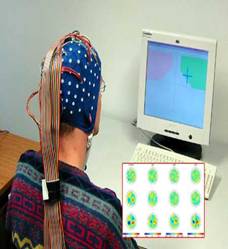
Wearing the fNIRS sensor, experimental subjects were asked to count the
number of squares on a rotating onscreen cube and to perform other
tasks. The subjects were then asked to rate the difficulty of the tasks,
and their ratings agreed with the work intensity detected by the fNIRS
system up to 83 percent of the time.


No comments